
Research Use Only Peptides:
What RUO Means for Buyers
Research Use Only means a peptide is supplied for laboratory research and is not approved, or intended, for human or animal use. It is a statement of intended use, not an exemption. FDA reads intent from everything a seller publishes, so an RUO label sitting underneath marketing copy about weight loss carries no protective weight at all.
The Correction Almost Every Peptide Site Gets Wrong
Search “RUO” and you will find page after page citing 21 CFR 809.10(c) as the source of the Research Use Only designation. That regulation is real. It is also about in vitro diagnostic products, and a lyophilized peptide is not an in vitro diagnostic.
This matters more than it sounds. Buyers who assume peptides sit inside a formal FDA carve-out are working from a false sense of structure. What actually governs a research peptide sold in the United States is much simpler and much less forgiving: if it is marketed for a therapeutic purpose, it is an unapproved new drug under section 505(a) of the Federal Food, Drug, and Cosmetic Act, and offering it for sale violates section 301(d).
RUO labeling, for peptides, is an industry convention that describes intended use. It is meaningful.
It is not a regulatory shelter.
Why the Research Use Only Peptides Disclaimer Keeps Failing
FDA has been explicit about this through enforcement rather than through new rulemaking. In September 2025 the agency issued more than fifty warning letters across the GLP-1 and peptide space, including a series specifically aimed at products sold as research use only where the surrounding advertising indicated human use.
On 7 April 2026 it published seven more against online peptide sellers, all dated 31 March, all built on the same argument.
The argument is not complicated. A disclaimer at the bottom of a page does not override what the rest of the page says.
If a product listing describes appetite suppression, if the site publishes a dosing calculator, if bacteriostatic water and syringes are in the same shopping cart, if there are before-and-after photos in the reviews, then the seller has communicated an intended use and the label text is irrelevant to the analysis.
The Adjacency Signals That Get Cited
- Product copy referencing weight, appetite, glucose, recovery, healing, muscle, sleep, libido, or any physiological outcome
- Dosing calculators, reconstitution calculators, or unit-conversion tools on the site
- Injection supplies, bacteriostatic water, syringes, or alcohol swabs sold alongside the compounds
- Customer reviews or testimonials describing personal use, left unmoderated
- Blog or social content comparing a research compound to an approved prescription drug
- Consumer-scale package sizes and consumer-style checkout with no buyer qualification
- Influencer or affiliate content the seller commissioned that makes claims the seller would not make directly
- Note how many of those have nothing to do with the product itself. Compliance posture in this category is a property of the whole storefront.
What the Buyer of Research Use Only Peptides Is Responsible For
Buyers sometimes read RUO as the supplier's problem. It is not, entirely. Once material is in your possession, lawful handling, storage, use, and disposal are yours, under whatever federal, state, and institutional rules apply to your organization.
- Document your research use. Keep an internal record of what your organization intends the material for. This is a five-minute document that becomes very valuable if anyone ever asks.
- Check your state layer. Several states regulate research materials, controlled analogues, and clinical practice more tightly than federal baseline. RUO status at the federal level does not preempt that.
- Check your institutional layer. Universities, hospital systems, and accredited labs generally have their own procurement and materials policies that sit on top of everything else.
- Watch your own marketing. If you resell or private-label, the objective intent analysis applies to your storefront exactly the way it applies to your supplier's.
What a Compliant Wholesale Peptide Supplier Looks Like
Buyer qualification exists and has teeth.
teeth. A real account application asking about entity type and intended research use, reviewed by a person, before catalog access. Not a checkbox.
Pricing is gated.
Public per-unit pricing on a consumer-style product page is a signal the seller is positioned for retail buyers regardless of what the disclaimer says.
Copy stays technical.
Specifications, formats, purity, storage, documentation. No outcomes, no conditions, no comparisons to approved drugs.
No injection supplies in the cart.
This is the single most-cited adjacency in recent enforcement.
Documentation is available up front.
Lot-level COAs a buyer can see before committing.
Reviews are moderated.
A testimonial describing personal use is user-generated content that the seller is nonetheless publishing.
Where Lifted Industries Draws the Line
Everything in the catalog is supplied Research Use Only, Not For Human Consumption. Accounts are gated behind qualification, pricing is not published publicly, and product pages carry specifications and documentation rather than outcome language. We do not publish dosing or reconstitution guidance, and we do not sell injection supplies.
Some of that costs traffic. A page that answers “how much should I take” would rank. We are not going to write it, and a supplier that will is showing you their risk tolerance, which by extension becomes yours.
What This Means for Your Account Type

Your practice-level obligations sit entirely outside RUO. Research-use material is not a substitute for a prescription pathway, and your supplier relationship should be documented as a research procurement relationship, not a clinical one. Talk to your own counsel about scope; we can only speak to what we supply and how.

Your practice-level obligations sit entirely outside RUO, even when research-use material sits alongside other services on your menu. Document the supplier relationship as research procurement, not as part of any protocol you offer clients. Talk to your own counsel about scope; we can only speak to what we supply and how.

Your prescribing authority does not convert research-use material into something it isn’t. Document the purchase as a research procurement relationship, filed apart from patient records, and keep that distinction clean in your own paperwork. Talk to your own counsel about how sourcing decisions interact with your license.

Confirm the purchase clears your institution’s materials policy and that intended use is documented in your own records. Your qualification paperwork with us is designed to be filed alongside that documentation, not to replace it.
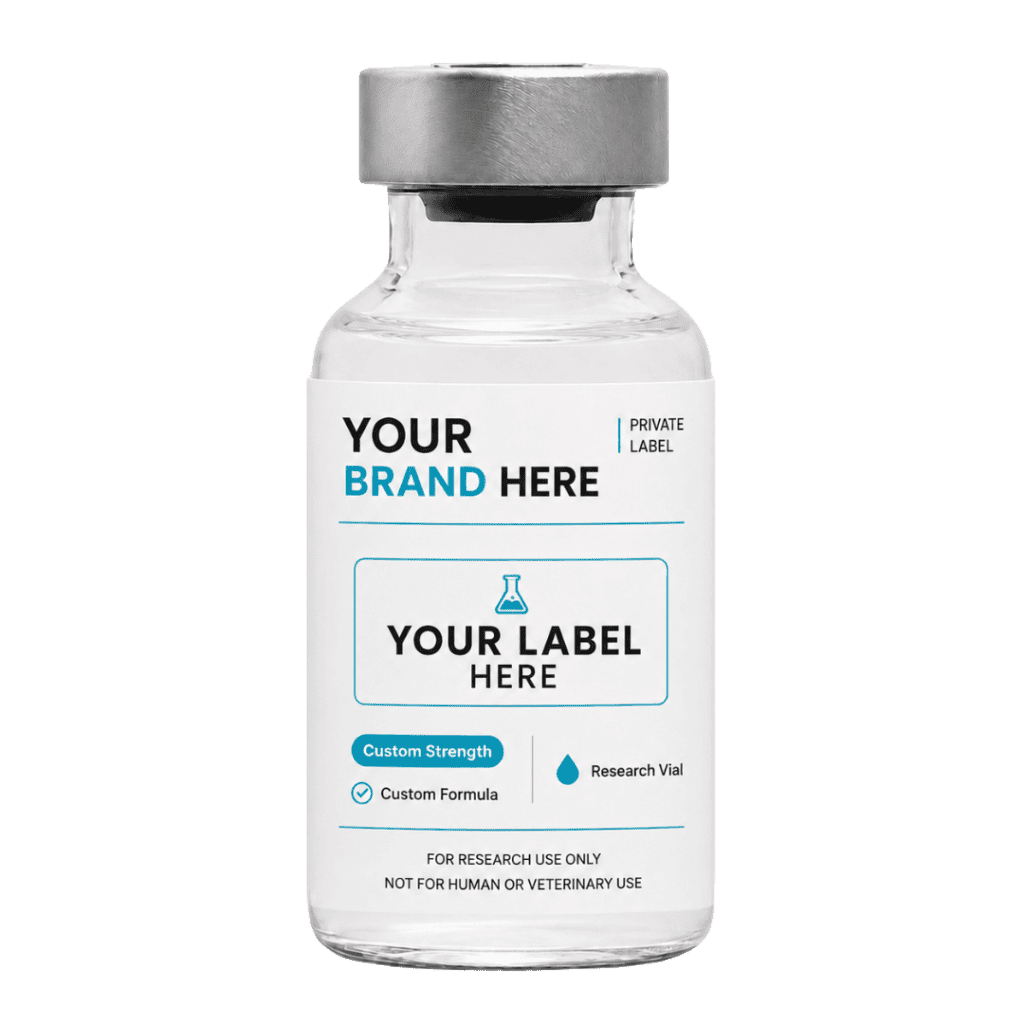
Your label inherits the full RUO obligation. Required language is not negotiable based on branding, and your own marketing becomes part of the objective intent picture the moment you publish it. Counsel review before launch is cheaper than counsel review after a complaint.
Frequently Asked Questions
It means the material is supplied for laboratory research and is not approved or intended for human or
animal use. For peptides it is a statement of intended use rather than a formal regulatory exemption.
Research materials can be sold and purchased for legitimate laboratory research. The legal problem
arises when a product is marketed for therapeutic use, at which point FDA treats it as an unapproved
new drug under section 505(a) of the FD&C Act regardless of any disclaimer.
Not on its own. FDA determines intended use from the totality of a seller's communications, including
product copy, adjacent products, tools, and testimonials. Recent warning letters have specifically
rejected RUO disclaimers where surrounding content indicated human use.
No. RUO material has not been evaluated by FDA for safety or effectiveness in humans, and an RUO
designation is not an approval, clearance, or endorsement of any kind.
Both, in different ways. The supplier is responsible for how it manufactures, documents, and markets.
The buyer is responsible for lawful handling, storage, use, and disposal once the material is in their
possession.
No. State and institutional requirements apply independently of federal RUO framing, and several
states regulate research materials more tightly than the federal baseline.
Because those pages attract search traffic. It is also one of the clearest indicators in recent FDA
enforcement that a seller has communicated an intended human use, which is why we do not publish
it.
No. Research Use Only compounds are intended strictly for laboratory and research applications, not for human or animal consumption. Marketing or selling RUO material for personal use falls outside its intended purpose and is the buyer's compliance responsibility to avoid.